
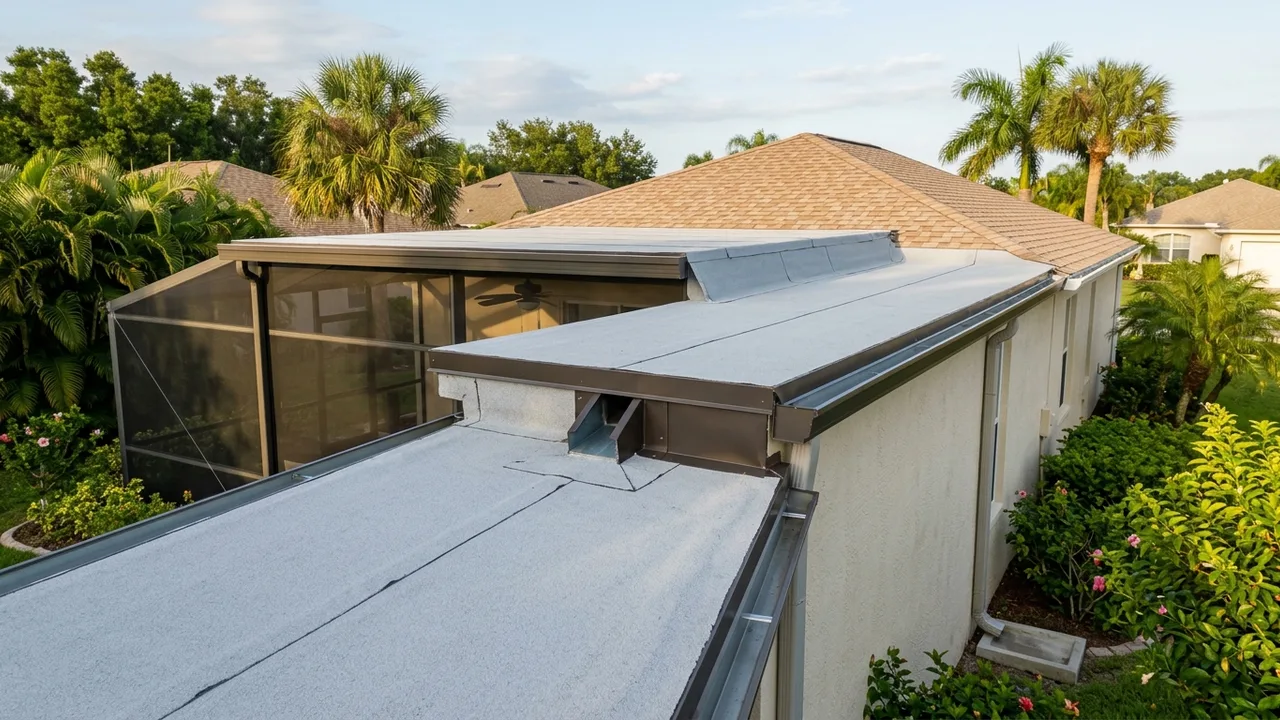
Flat & Low-Slope Roofing in Fort Myers
TPO, EPDM and modified-bitumen work on additions, lanais and low-slope sections where a membrane system, not shingles, is the right fit.
Who flat and low-slope roofing is for
Flat and low-slope roofing covers the parts of a Fort Myers home that a shingle or tile roof cannot protect well: additions, lanais, carports, porches and low-pitch sections where water simply does not run off fast enough for a pitched covering. This service takes in TPO, EPDM and modified-bitumen membrane systems, plus leak repair on existing flat roofs. It suits homeowners with a leaking or aging flat section, or a new addition that needs a membrane rather than shingles over the top. When you first reach out we ask what the flat area covers, roughly how big it is and what you are seeing up there. An independent Florida roofing contractor inspects the membrane, the seams and the drainage, since ponding water and failed seams are the usual reason a flat roof starts to leak.
Choosing a flat roof membrane that lasts
A flat roof membrane is a different animal from a pitched roof, and picking the right one matters more than people expect. TPO is a light single-ply membrane, usually white, that reflects heat well and turns up often on residential low-slope work. EPDM is a hard-wearing rubber membrane with plenty of flex in it. Modified bitumen is a tough multi-layer system that suits areas seeing the odd bit of foot traffic. The thread running through all three is that a flat roof lives and dies by its seams and its drainage. Water does not sheet off a low slope the way it pours off a pitched roof, so ponding, blocked drains and split or lifted seams are exactly where the leaks start. A flat roof done properly gets the falls and the drainage right, welds or bonds the seams cleanly, and details the edges and penetrations so water has nowhere to sit and soak in. On a repair, a good contractor traces the leak to the failed seam or flashing and fixes that, rather than rolling a coating over the whole surface and hoping the problem stays buried for a season.
What flat and low-slope roofing covers
TPO membrane installation
A reflective single-ply membrane, heat-welded at every seam, widely used on residential low-slope roofs where turning the Florida heat back off the roof matters.
EPDM rubber membrane
A hard-wearing rubber membrane suited to flat sections that need a long-lasting cover with enough flex to handle movement and heat.
Modified-bitumen roofing
A tough multi-layer bitumen system chosen for low-slope areas that see occasional foot traffic and need a little extra durability underfoot.
Low-slope leak repair
The leak is traced back to the split seam or failed flashing that caused it and repaired there, not coated over blindly across the whole roof.
How working with us works
Tell us what is going on
Share your flat & low-slope roofing enquiry and what you are seeing on the roof, plus its age and material.
On-site inspection
A Florida roofing contractor inspects the roof so your flat & low-slope roofing is scoped to what is actually there.
Options and written estimate
You get clear options and a firm written estimate for the flat & low-slope roofing, with any earlier figure treated as indicative.
The work, done right
Once you approve, the flat & low-slope roofing is carried out to Florida Building Code standards and checked on completion.
Why homeowners use us for flat roofing
Seams and drainage come first
Flat roofs leak at their seams and wherever water is left to pond, so those are the first things inspected and put right, not papered over with a fresh coating.
The right membrane for the spot
TPO, EPDM and modified bitumen each suit different situations, and the choice is matched to your particular roof and how it drains rather than to one default product the crew always fits.
Repairs traced, not smeared over
A leak is followed to the failed seam or flashing so the repair targets the real cause, instead of a coating rolled across the whole surface in the hope it holds.
Why does my flat roof membrane keep ponding and leaking?
Recurring leaks on a flat roof almost always come down to two things: water that sits instead of draining away, and seams that have split or lifted. Because a low slope cannot shed water quickly, any dip, blocked drain or slight sag lets water gather and pond, and standing water works its way into every weak seam and penetration over time. Rolling a coating across the whole surface can hide the symptom for a season, but if the falls and the drainage are wrong the ponding comes back and the leak returns with it. A repair that lasts corrects the drainage where the structure allows, renews the failed seams and flashing, and details the edges so water is pushed off the roof rather than left to pool. An inspection sorts out whether you need a contained seam repair or a fuller membrane renewal, so you are putting the money toward the cause rather than a coating that buys a few dry months and then hands the problem straight back to you.
Flat & Low-Slope Roofing: common questions
What is a flat or low-slope roof and how is it different?
How much does a new roof cost in Fort Myers?
How much does roof repair cost in Fort Myers?
Is it cheaper to repair or replace a roof?
How do I know if my roof needs repair or replacement?
Flat & Low-Slope Roofing across Fort Myers
Pick your neighborhood for the local notes, or submit the form for a free review.
Talk to a specialist
Ready to sort your flat & low-slope roofing in Fort Myers?
Share the details and we will help you take the next step with confidence.